
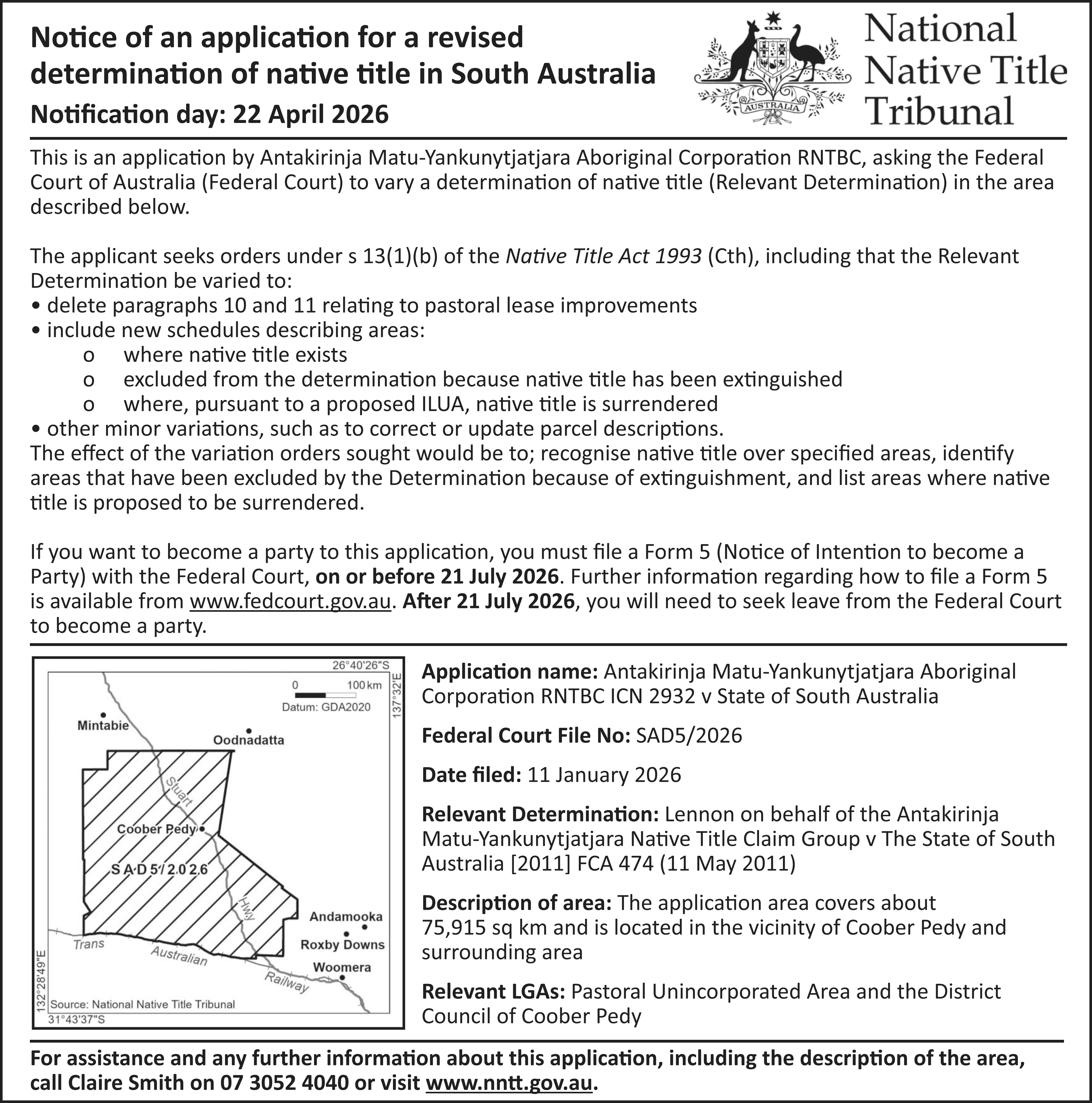
A public notice has been issued advising that an application has been made to the Federal Court to revise an existing Native Title determination covering the Coober Pedy region and surrounding areas.
A public notice has been issued advising that an application has been made to the Federal Court to revise an existing Native Title determination covering the Coober Pedy region and surrounding areas.
The Antakirinja Matu-Yankunytjatjara Aboriginal Corporation has applied to the Federal Court of Australia to revise the 2011 native title determination covering approximately 75,915 square kilometers in the Coober Pedy region. While this is an update to an existing decision rather than a new claim, the proposed changes carry significant weight for local livelihoods, particularly regarding how land is managed on pastoral leases and within mining areas. By removing specific clauses that previously excluded native title from areas containing pastoral improvements like sheds, dams, and airstrips, the revision shifts the landscape from one of automatic exclusion to one of co-existence and negotiation.
For PASTORALISTS, this represents a fundamental change in land control. Under the original 2011 rules, infrastructure and the land immediately surrounding it were largely treated as areas where native title was “wiped out,” giving the leaseholder clear, unilateral authority. The removal of these paragraphs means that native title rights may now overlap with these improved areas, potentially requiring more formal discussions and access agreements rather than relying on automatic legal exclusions. This creates a greater need for pastoralists to engage directly with native title holders to ensure operational certainty.
OPAL MINERS face a similar shift toward a more structured and agreement-based system. The revision aims to provide high-precision mapping to clarify exactly where native title exists, where it has been extinguished, and where it is being surrendered through Indigenous Land Use Agreements (ILUAs). While this increased clarity can reduce long-term legal uncertainty, the reliance on ILUAs means that future mining access and exploration may depend more heavily on successfully negotiated outcomes and specific permissions rather than broad historical assumptions. In essence, the region is moving away from rigid legal rules toward a model of negotiated co-management.
Because these changes will redefine land use and development approvals across the District Council of Coober Pedy and surrounding pastoral areas, the community has a limited window to respond. Anyone whose interests, be they mining claims or pastoral leases, may be affected has until 21 July 2026 to file a Form 5 with the Federal Court to become a party to the application. After this date, participating in the legal process becomes significantly more difficult, leaving the future of land access to be decided by the court and the current applicants.
Further information is available through the National Native Title Tribunal.
Discover more from Coober Pedy Regional Times
Subscribe to get the latest posts sent to your email.
Categories: GENERAL News

